West Stormont
Woodland Group

Scottish Charitable Incorporated Organisation (SCIO) SC051682

Join us today to bring Taymount Wood and Five Mile Wood into community ownership

“Exits, Entrances and Crossroads” by Margaret Lear

Is there an artist in the wood? There is, really, only one easy way into and out of Five Mile Wood - at least in October. That's from the south end on the Stanley to New Mill cottages road - currently a bit of a no man's land thanks to the dualling of the A9. Here the track is clear, broad, made for forestry vehicles - and you can even park! At the north end, there is also the old straight track I've written about before, from South Barns and beyond that, with a diversion to Bankfoot. Follow the line of this track and it will take you to Dunkeld, once a mighty ecclesiastical seat. I learned last week that from Dunkeld to the wood it's five miles - hence the name.
West Stormont Woodland Group

I wonder what happened to One, Two, Three and Four Mile Woods?

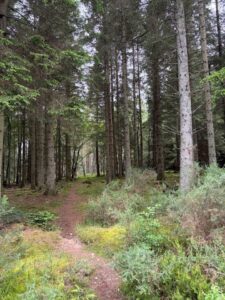
But once through the gate at the end of the straight track, the going is tricky. At this time of year, wellies are essential, thanks to the legacy of ditches, boggy ground and waterlogging that followed the felling of the trees here. When did it become the norm for forestry practice to leave such a mess? However, with care, agility and thanks to the enterprising actions of previous walkers using felled timber to ford the worst ditches, you can get to the main path that circles the wood.

Deer, birds and other animals have their own paths off into the undergrowth, but for humans, the area where trees were felled before the Commission ceased to work are becoming impenetrable. Gorse crowds thickly on either side of the track, requiring constant maintenance to keep it from meeting in the middle. Self-seeded birch, larch, Scots pine and willow are all growing well, but there are no paths between them in this baby wood. Then there are the trackside deep ditches, another legacy of forest drainage operations, not impossible to cross but very off-putting.

So walkers, joggers and cyclists stick to the circular path and leave the wood by the way they came. Someone on Trip Advisor found the wood disappointing, and the circular track through felled forest boring.

But I wonder. We undervalue landscapes that aren’t “finished” – such as newly planted gardens and self- seeded woods at the start of succession. The prettiest part of Five Mile Wood may be the winding bike- track under mature trees which shoots off from the main path near the south entrance, but the burgeoning growth of pioneer vegetation in the centre – the “gap site” as some call it – is vibrant with hidden life, resounding with the flickering flight of small birds and bubbling with amphibians and aquatic life in the ponds and ditches created for drainage.

Even the nuisance gorse is a rich nectar source for pollinators and home, each bush, to thousands of spiders and other invertebrates. It’s not what we are schooled to believe beautiful, but in terms of ecology and resilience, it is every bit as valid as ancient oak climax woodland. Not all landscapes can be measured in human terms – though the amount of carbon sequestered by rapidly-growing trees and shrubs will be enormous and far greater than that in a carefully-planned, gardenesque setting. And humans need carbon sinks as much as every other life form. People like to have choices, though. Choices about where to enter the wood – entrance points close to all the settlements that lie within walking distance. New tracks to follow, new routes to explore, the chance to come out into the sunshine at a different point from where you went in. Paths that cross, diversions, sidetracks, viewpoints. I don’t think they should be the main focus of the wood, or dominate the richness of undisturbed wildlife in the centre. There must be places that are no-go areas for humans, where nature can get on with it, and prove, as ever, that she will make a better job of it than we can.

And then, let our tracks meet and link wood to wood, as we learn to walk more, and be more in nature and less apart from it. Then we will lose our expectations of park furniture and entertainment, and realise the woods aren’t, in the end, all about us.
Share:

Facebook
Email
LinkedIn
Print

Previous Articles

Community Monthly Update – July 2026

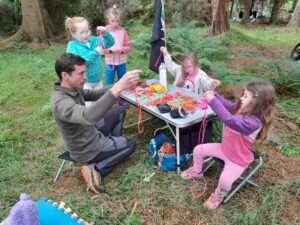
On 6 July, we had our second Wee Adventures bushcraft day of 2026 in Taymount Wood. In the morning, a group of 4-8 year old children enjoyed a wonderful session of knot-tying, shelter building, tree climbing, swing and pull-up construction, ditch-jumping, skipping, mag posts, fairy-house creation and more. In the afternoon, a group of adults with visual or hearing impairment, carers, Vision PK staff and WSWG volunteers joined Biscuit for a variety of bushcraft activities and wide-ranging chat over a picnic in our glorious woodland setting, beautifully tranquil apart from the hourly accompaniment of a very noisy bird-scarer in a nearby field! Adults and children alike enjoyed the delicious picnic boxes from Alison’s Kitchen in Blairgowrie. Thank you to all our much-valued WSWG volunteers who helped out on the day.

Read More »

Community Monthly Update – June 2026

On 28 May, WSWG had an excellent site visit to Taymount Wood with Jen Davidson and Munro Kerr to share with them what WSWG wishes to achieve for nature recovery and community through the proposed Management Agreement with FLS and seek their views and advice. Jen is the Conservation and Projects Officer at Perth and Kinross Countryside Trust, where she is the co-ordinator of the Nature Connections Partnership Perth and Kinross and the lead for the Climate Connect Perth and Kinross Nature Network which WSWG is part of. Munro Kerr runs a nature recovery business with Alasdair Worrell – Alba Fiadhaich (Ala-ba Fee-ah-eich), its translation being akin to “Wild Scotland”.

Read More »

Community Monthly Update – April & May 2026

A very big thank you again to the Highland Community Energy Society for continuing their support of WSWG as a beneficiary of community funding each year from their Littleton Burn Hydro Scheme at Dalguise. It is a particularly valuable and versatile donation for WSWG each year, so is very much appreciated. Have a look at the WSWG Case Study on their website to remind you of how we have used their funding over the past few years. Visit www.hces.coop and search for the Community Fund.

Read More »

Community Monthly Update – March 2026

Tragically, on 11 February, the PKC Planning and Placemaking Committee voted unanimously to approve the proposal for an intensive poultry rearing unit at Newbigging Farm adjacent to Taymount Wood, despite substantial local objection, including from WSWG and many of our members. The only mention of our community woodland in the planning report was as screening for the development and as a buffer for any pollution of King’s Myre Loch SSSI from the production unit. Needless to say, we are extremely sad and disappointed at this outcome.

Read More »
WSWG - woodland pathway

Community Monthly Update – January 2026

Slightly belatedly, a very Happy New Year to all our members and supporters and here’s to a good one for us all. We’ve been hinting over the past couple of months at a change of direction for the WSWG Project and so the main purpose of January’s Community Monthly Update is to tell you a bit more about where we are heading in 2026.

Read More »

Community Monthly Update – December 2025

Where has 2025 gone? Hopefully our regular newsletters will have kept you in touch with the WSWG Project throughout the year. You can look back at all our Community Monthly Updates on our website to remind you of the diverse activities and connections we have enjoyed. In the meantime, here are a few photos of some of the new activities which took place in 2025. And to all our members and supporters, the WSWG Board of Trustees would now just like to wish you a very happy festive season and we look forward to catching up with you again in 2026.

Read More »