West Stormont
Woodland Group

Scottish Charitable Incorporated Organisation (SCIO) SC051682

Join us today to bring Taymount Wood and Five Mile Wood into community ownership

Little Pictures, Big Pictures

Wandering into Five Mile Wood last week, I was considering what might turn out to be the wood’s gift this month when I got distracted by a long-ago fallen log. Or rather, the holes in it.

A close inspection did not reveal who made the holes, nor what was living in them, but “invertebrates” I thought, are the gift of the woods.
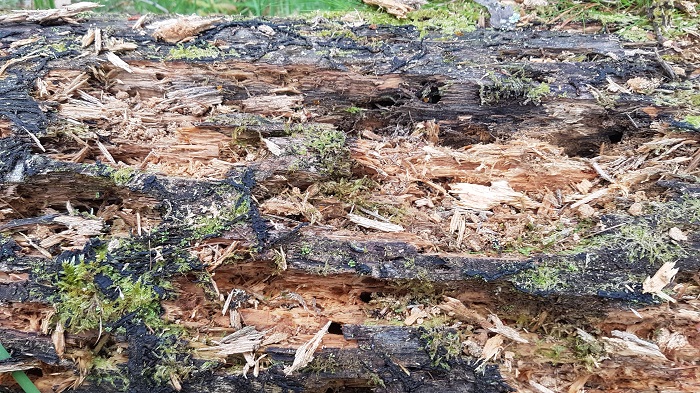
Five Mile Wood has no shortage of fallen timber, stumps and standing dead wood, and invertebrates, from wood-boring beetles to the ants revealed by moving a section of mashed wood (who refused to stay still and pose for a photograph) are constantly processing all this material. The term is detrivores – eaters of detritus. They demolish it, digest it, live in it, reproduce in it and become prey for larger animals such as woodpeckers, who continue the process.
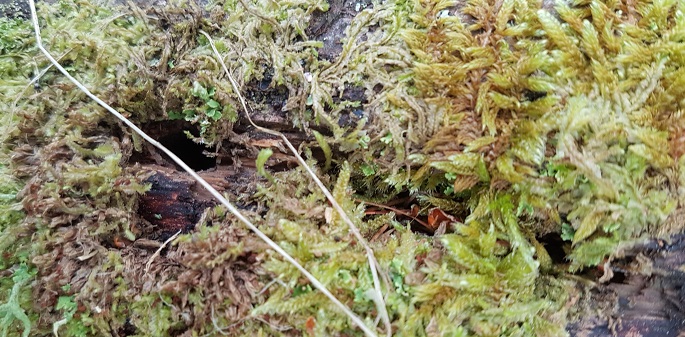
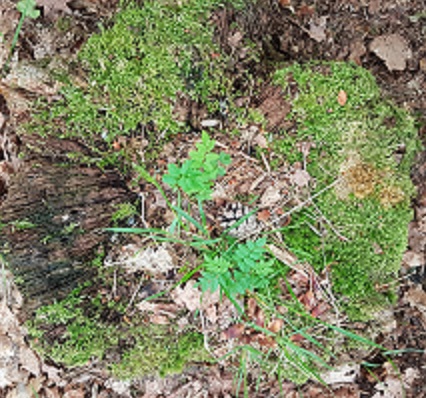
They do all this in conjunction with primitive plants such as algae, liverworts, lichens and mosses, who use rain and weather to colonise the rotting wood, and turn every stump into an unimaginably beautiful and complex micro-universe – ever-changing, adapting, a garden busy with life and death. The death of a slug grazing on algae on a log creates nutrients for more life to form. Do not forget the fungi, those other agents of decomposition, active undetected within the wood, until you notice the rhizomorphs – black strands of fungal hyphae lurking under the shattered bark – or the curious buttons that will turn into this season’s fruiting bodies.
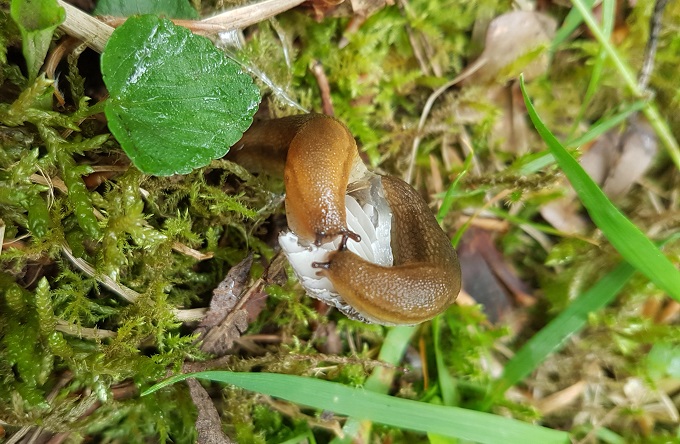
Fungi attract more invertebrates – like the slugs I found breakfasting forensically on an early toadstool and who did stay still enough to be recorded. As huge fruiting bodies break down, more life teems to populate their remains.
Such beauty in the process of decomposition! The parts we can see – trails of bark beetles, the subtle colouration of heartwood from fungal incursion, the mystery of camouflaged holes and the patterns of the obvious ones! And the wonder, the glory, withheld in the bits we cannot see…..

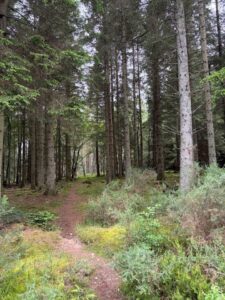
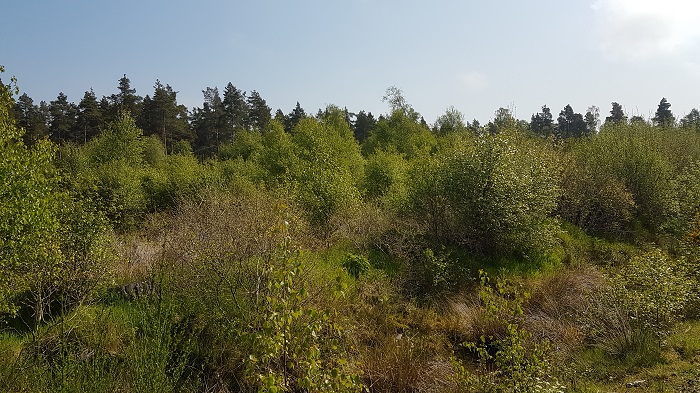
I emerged very satisfied, through mud and ditch, under and over fallen trees, onto the path in the “Gap Site” centre of the wood, which tingled with birdsong. What gap site? There are clearly no gaps here, bar the path itself. I couldn’t believe how tall the regenerating birches and willows are now, how golden the gorse, how vibrant with life it was.

No one has planted it, yet here is an exuberant young wood romping through the processes of succession and change, home to plants and animals we may never see. I belong to a number of on- and offline groups which are either about rewilding, or in which rewilding is an important topic of conversation. The question – and the challenge – is this: Is rewilding something that happens, or something you do? It’s a question that incurs endless debate, even argument, among people who essentially all want nature to succeed. A lot of disagreement ranges around whether gorse is “good” or “bad” or whether it’s just gorse. Should we graft our values onto other species? Are we in control – should we be? Do we try to manipulate nature to give us the kind of rewilding we want? If we don’t, is this a cop-out, allowing invasive, non-natives such as Giant Hogweed to predominate? Will we end up drowning in Rhododendron ponticum, effectively smothering plant diversity and devastating the range of animal species? Do we plant our preferred species now, or wait for natural succession to see them “arrive”?
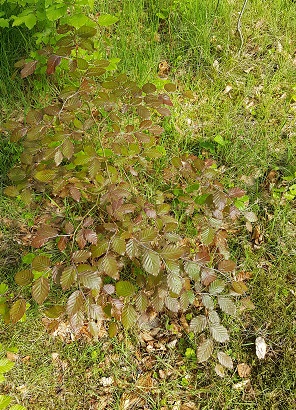

Take the “Gap Site”. Here’s a wee Rowan tree – how good is that! But shall we pull out this alien copper beech sapling nearby? Or maybe all the beeches, after all, they’re not native to Scotland! Here’s a nice Scots Pine. But oh dear, the self-sown spruces by the path are a menace; we don’t want another plantation….do we? Do we want the gorse and larch saplings to create an interesting tunnel-like avenue as we come out of the gap into mature woodland? Is it pretty? Does it need to be?
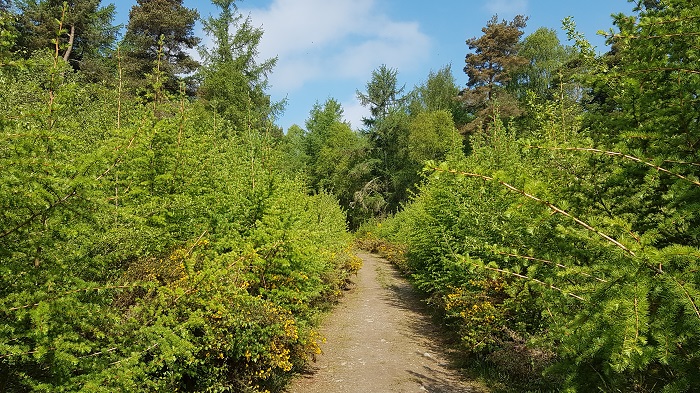
Gorse and larch make a curiously intimate avenue

I don’t have answers to this challenge and am as conflicted as the next person. But I do believe that we all need to be aware of the question and hold it in our minds when we think about the future of our woodlands.
Share:

Facebook
Email
LinkedIn
Print

Previous Articles

Community Monthly Update – July 2026

On 6 July, we had our second Wee Adventures bushcraft day of 2026 in Taymount Wood. In the morning, a group of 4-8 year old children enjoyed a wonderful session of knot-tying, shelter building, tree climbing, swing and pull-up construction, ditch-jumping, skipping, mag posts, fairy-house creation and more. In the afternoon, a group of adults with visual or hearing impairment, carers, Vision PK staff and WSWG volunteers joined Biscuit for a variety of bushcraft activities and wide-ranging chat over a picnic in our glorious woodland setting, beautifully tranquil apart from the hourly accompaniment of a very noisy bird-scarer in a nearby field! Adults and children alike enjoyed the delicious picnic boxes from Alison’s Kitchen in Blairgowrie. Thank you to all our much-valued WSWG volunteers who helped out on the day.

Read More »

Community Monthly Update – June 2026

On 28 May, WSWG had an excellent site visit to Taymount Wood with Jen Davidson and Munro Kerr to share with them what WSWG wishes to achieve for nature recovery and community through the proposed Management Agreement with FLS and seek their views and advice. Jen is the Conservation and Projects Officer at Perth and Kinross Countryside Trust, where she is the co-ordinator of the Nature Connections Partnership Perth and Kinross and the lead for the Climate Connect Perth and Kinross Nature Network which WSWG is part of. Munro Kerr runs a nature recovery business with Alasdair Worrell – Alba Fiadhaich (Ala-ba Fee-ah-eich), its translation being akin to “Wild Scotland”.

Read More »

Community Monthly Update – April & May 2026

A very big thank you again to the Highland Community Energy Society for continuing their support of WSWG as a beneficiary of community funding each year from their Littleton Burn Hydro Scheme at Dalguise. It is a particularly valuable and versatile donation for WSWG each year, so is very much appreciated. Have a look at the WSWG Case Study on their website to remind you of how we have used their funding over the past few years. Visit www.hces.coop and search for the Community Fund.

Read More »

Community Monthly Update – March 2026

Tragically, on 11 February, the PKC Planning and Placemaking Committee voted unanimously to approve the proposal for an intensive poultry rearing unit at Newbigging Farm adjacent to Taymount Wood, despite substantial local objection, including from WSWG and many of our members. The only mention of our community woodland in the planning report was as screening for the development and as a buffer for any pollution of King’s Myre Loch SSSI from the production unit. Needless to say, we are extremely sad and disappointed at this outcome.

Read More »
WSWG - woodland pathway

Community Monthly Update – January 2026

Slightly belatedly, a very Happy New Year to all our members and supporters and here’s to a good one for us all. We’ve been hinting over the past couple of months at a change of direction for the WSWG Project and so the main purpose of January’s Community Monthly Update is to tell you a bit more about where we are heading in 2026.

Read More »

Community Monthly Update – December 2025

Where has 2025 gone? Hopefully our regular newsletters will have kept you in touch with the WSWG Project throughout the year. You can look back at all our Community Monthly Updates on our website to remind you of the diverse activities and connections we have enjoyed. In the meantime, here are a few photos of some of the new activities which took place in 2025. And to all our members and supporters, the WSWG Board of Trustees would now just like to wish you a very happy festive season and we look forward to catching up with you again in 2026.

Read More »